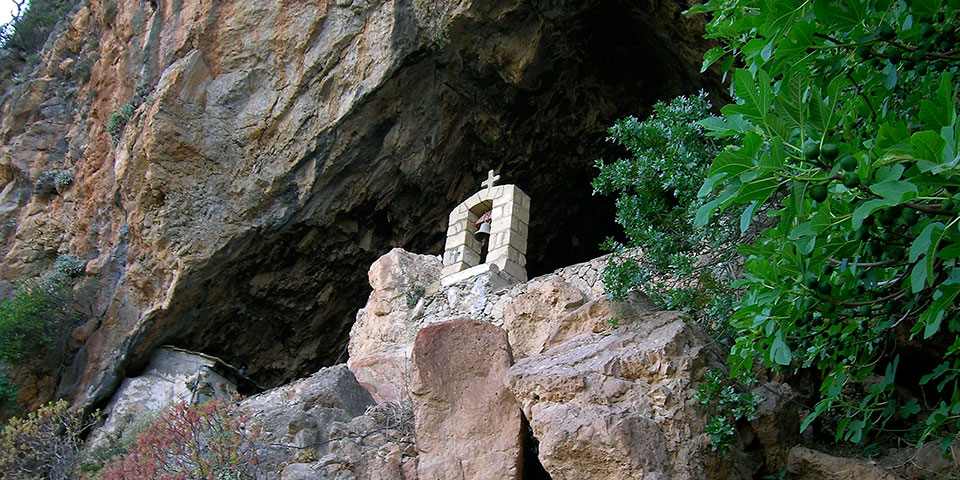
When driving in western Crete at Kisamos County, on the road heading to Elafonissi just after the village named Topolia, you will go through a small tunnel. Exactly at the tunnel’s exit, high up on your right, you will see the opening of a cave and an unusual metallic star reflecting the sun’s rays.
This is the entrance to an interesting cave named Agia Sofia. From the street level you have to climb quite a few steps and then continue walking through a small path. As you get closer to the cave, you realize the opening is actually quite big, and little by little the roof of a quaint church begins to appear on the left. Actually, the church is situated inside the cave itself, which is why they both bear the same name.
Upon entering the cave of Agia Sofia, you suddenly realize that it is in fact quite large, almost the size of a cathedral. According to official findings the cave of Agia Sofia is at an elevation of 285 meters, and includes a cupola 20 meters high and 70 meters in diameter with various forms of stalactites (deposits which hang down from the ceiling of the cave) and stalagmites (deposits that project upward from the ground of the cave). Many ancient objects were discovered at this location, including shells from the Neolithic period.
After taking a few hesitant steps until the eyes adjust to the dim light, continue towards the little church, which is in the front on the left side of the cave, and actually forms one of the church’s walls. The church is small and quite ordinary, without any architectural or hagiographical features. What makes it unique is the sense of space once you are inside.
Returning to the outside cave again, with eyes that are now hopefully accustomed to the darkness of the area, we begin our exploration.
The size of the stalagmites is truly unbelievable, with some of them measuring a staggering five to six meters. The stalactites are approximately the same dimensions. But they are still a long way from joining in the middle – in fact they are still about four to five meters apart – which will give you some idea of the size of this cave.
In several locations of the cave wild fig trees have grown, and there are many pigeons throughout the area. Walking deeper into the cavern the humidity becomes very pronounced – the ground soaked with water, but not particularly slippery.
In several spots alga has completely covered the rocks, providing them with a dark-green velvet-like coating. The stalagmites offer a never-ending variety of shapes, ranging from extremely tall conical formations to very short form which somewhat resemble to top of a bald head.